
Back in the good old days of running a business, if you wanted to get your message out, you advertised. You might put a print ad in the New York Times or run ads on the big TV networks. Sometimes, people saw the ads, and sometimes, they would buy.

But things are different now.
We operate in a fragmented world where you choose the news you want to consume. When you go to “your” news outlet, you see a very narrow range of views, thoughts, ideas, products, and services. Everything is aimed only at people like you.
Even the big online players, such as Google, Hulu, MSN, or Amazon TV, have become more narrow and tailored in the ads shown on their platforms. And if you go to your social media feeds on LinkedIn, Facebook, Instagram, or anywhere else, you are seeing a unique feed with a mix of posts and ads not shown to anyone else. Your feed is carefully curated by an algorithm based on your demographic and browsing data.
In this environment, mass media isn’t nearly as valuable to businesses. The old-fashioned approach wastes most of your advertising impact. What does work? Influencers.
The Importance of Influencers
Consider this scenario to help understand the importance of influencers in today’s world.
Let’s say I sell juggling balls in California. Advertising in the LA Times will waste most of my money because 99% of the readers don’t juggle.
But let’s imagine that I could work with Josh Horton.
Josh is an expert on juggling in Los Angeles, and he’s someone Californians are looking at for information about juggling. So getting Josh Horton on board would be pretty valuable to help me sell more juggling balls. And I’d surely be willing to pay him, because my advertising dollars would have a much more targeted impact.
That’s the idea behind influencers. An influencer is someone who is not a buyer themselves but who influences the buying decisions of others. That juggling expert may not be a household name, but he’s someone that other local jugglers consider an authority—and those buyers are the ones who matter.
The same is true for any influencer who people turn to for things like:
- Parenting advice
- Cybersecurity
- Religious growth
- Interior design
- Clothing trends
- Dieting tips
- Relationship advice
- Getting into college
- Beauty products
… and every other imaginable service and product and topic.
Look at Misty Luukkonen of Little Green Bean who has made a name for herself in the sewing industry:

Once someone is an expert, their opinion carries weight. This is the same idea behind the testimonials you see at the beginning of books — some people’s opinions matter more than others.
And that’s the important part here.
Influencers aren’t just “celebrities.” Many Influencers today aren’t names you can drop around the dinner table and expect all generations to know whom you’re talking about. Often, influencers live in a silo, only wielding influence around a niche group of specific buyers.
Where Did Influencer Marketing Begin?
Let’s take a detour and consider where this all came from.
Influencer has become a big buzzword in many marketing circles, but the idea isn’t as newsworthy as you might think. A guy named Michael Blatter claims he coined the word influencer in 1994 when he determined that bartenders were the influencers for which alcoholic drinks would sell the fastest.
The term is probably much older than that.
In 1760, Josiah Wedgwood tapped into the royal family’s influence to grow his brand as “The Potter to Her Majesty.” In 1882, actress Lillie Langtry became the first woman to endorse a commercial product when she was in an advertisement for Pears’ Soap. And who can forget Wayne Dunafon, the Marlboro Man from the 1950s?

Image Credit: Advertising Principles
Despite this long history, the term “influencer” wasn’t added to the dictionary until 2016, which seems long overdue considering there were books written on influencer marketing over a decade ago, and in 2015, P&G paid “mommy bloggers” to help sell diapers and baby items.
So, influencer marketing is not new, but the proliferation of influencer marketing is. This strategy has quickly gone from being a niche to being HUGE BUSINESS.
The Financial Side of Influencer Marketing
Catching niche attention makes sense. And there’s a long history that shows influencer marketing works. Now, let’s look at the financial side of this strategy.
Some influencers share products with their audiences because they feel a sense of prestige and power. Others might share because they’re passionate about handbags, makeup, auto parts, or crocheting.
But as time has gone on and more people have learned that they are worth big money to businesses, influencers have started charging what they are worth. And they can make a lot. Check out Garden Answer as an example.
Garden Answer is a YouTube channel that shows at-home gardeners how to grow beautiful plants, vegetables, and even create fairy gardens as seen above. You might find this type of content riveting, or you may find it boring. But either way, you should pay attention to this: this channel is estimated to earn as much as $1 Million per year from their videos and influence status in the gardening industry.
RV Miles is another example of a profitable YouTube channel. It focuses on the RV lifestyle and was first pulled together by a family who, at the time, lived in their RV full-time.
The average influencer makes $58k a year. Not bad! But anyone with a math background knows to take this figure with a grain of salt because the highest-paid influencers make up the majority of the average, skewing the results. That means there are probably a lot of little people who make close to nothing.
This skewed view of the industry is similar to the real estate market, where the average realtor makes $100k a year. But anecdotally, the majority make much less. Indeed.com shows a more realistic view, with a big range of $50k—$199k/year.
The Ethical Side of Influencer Marketing
So because of the skewed salary ranges, there are some serious ethical concerns with influencer marketing. It gets tricky when an audience cannot tell the difference between an unbiased review and a paid promotion.
The Federal Trade Commission (FTC) has tried to clarify the ethics of transparently sharing when someone is just fawning over something they like and when they’re being paid to promote it. In 2017, the FTC released new guidelines for social media influencers to be more transparent about their paid partnerships. For example, influencers can’t use vague hashtags to disclose a partnership, such as #collab or #thanks. Instead, they must tag the paid partnership so it’s clear there was a value exchange made between the brand and the influencer.
Look at the disclaimer on this workout video. The words “paid promotion” make it pretty clear that this is a sponsorship.
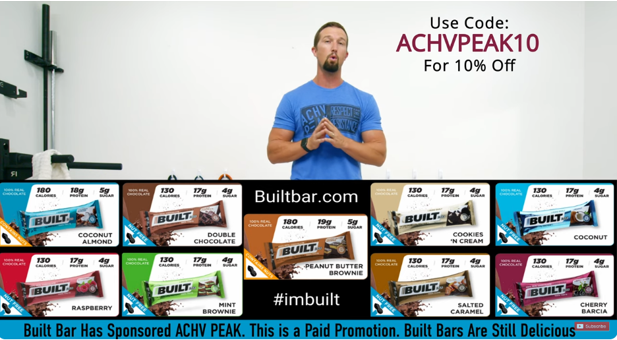
That’s transparent. However, other influencers don’t openly disclose their affiliation with brands and instead ask their followers to comment for direct links.
This seems like a grey area of business ethics. What if the influencer really DOES love the product or service? Does the fact that they are now being paid change that? The answer is YES. Being paid creates an invisible bias 一 sometimes so strong that the influencer won’t even realize s/he is biased in their review.
Bloggers and influencers must disclose that they are being paid at some point in sharing products in a way that is “clear and conspicuous.” But exactly when that disclosure must happen has remained somewhat unclear.
I will continue to unpack influencer marketing in the rest of this series. For now, keep your eyes open to where influencer marketing could benefit your business … or whether your influencer status could benefit other businesses!


