
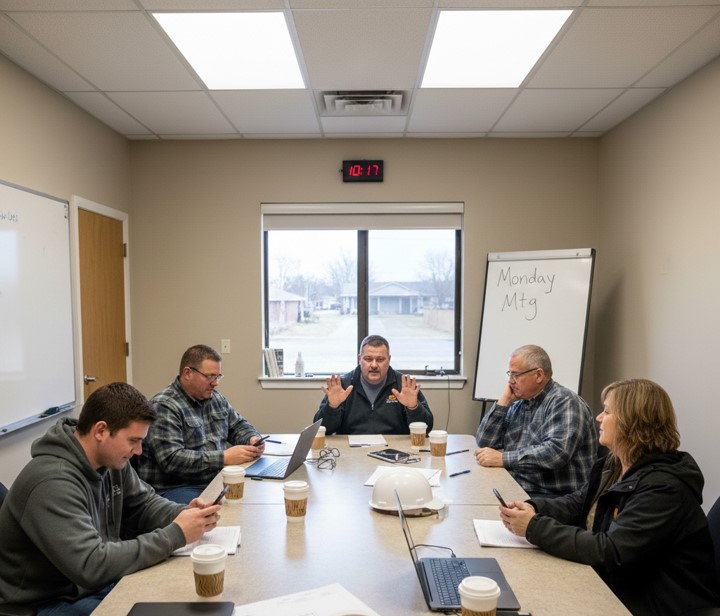
We’ve all been there: trapped in a room or in a conference call while someone goes on and on about something that could have been a three-line email.
Purposeless meetings are a huge waste of time and resources, which is especially painful if you’re the one paying everyone’s salaries. Even if they’re not as bad as this humorous take on conference calls:
As a business owner, you likely fall into one of two groups. Either you avoid meetings like the plague, or you fill your calendar with unproductive meetings. Both are bad choices. You need human interaction to map things out collaboratively, brainstorm, and get different perspectives on business challenges and opportunities. But you don’t need to pull numerous people out of their workflow to “share updates” or to go in circles over the same issue over and over again.
To scale your business, you have to stop “having” meetings and start running them. Over the years, I’ve run thousands of meetings and sat in on countless aggravating time-wasters, too. So I’m going to share some strategies that work. Here goes.
Set ground rules
If you start ten minutes late, you aren’t just losing ten minutes. Multiply that by every person in the room. Therefore: start on time, end on time.
This is a big one. Don’t skip — reschedule. If someone has a conflict and you just “skip til next time,” you signal that the meeting wasn’t important anyway. If there’s a conflict, move it. This prevents a passive-aggressive “ditching” culture.
Finally, enforce a phone ban. This feels awkward at first, but when people are actually present, you can make decisions in much less time.
Have an agenda and stick to it
Meetings without an agenda are often aimless. You need to provide a clear statement of why everyone is there.
Cap the “how was your weekend?” shmoozing at three minutes. Then start. Take control of the room. Think of it this way: someone needs to run the meeting, and it looks like it’s you!
Your opening line should be something like: “Let’s start. What we want to get done in the next 30 minutes is…”
Stick to the agenda. If other items come up, don’t let them derail the meeting. Make a note of them but keep things focused. You can say something like “OK, that’s an important point, but not for right now. We can discuss that separately.”
The Finish Line: give a recap
The most important part of a meeting happens after it ends. If it isn’t written down, it didn’t happen.
First, give a verbal recap to wrap up the meeting. Close by saying: “Great, we’re done. Here is what we decided.
Follow up with a “Who, What, When” email. One of my clients told me the most important thing she learned from our meetings was the recaps! They can be short, but they must name who will do what and when 一 the person responsible, the specific task, and the deadline.
Finally, make sure that the next step is in place. For accountability, use the end of the meeting to schedule the next check-in. This keeps the momentum from evaporating.
The Bottom Line
Productive meetings are the heartbeat of a growing company. Don’t avoid meetings, but know why each one exists and make the most of them with the guidance I’ve given you. When you run meetings with discipline, you stop wasting time and start moving the needle.


